
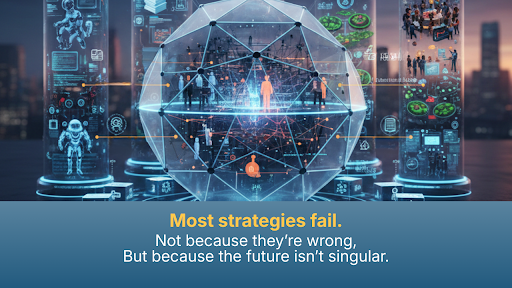
If the last five years taught me anything, it’s this: The future doesn’t arrive gradually. It arrives unevenly.
A regulation changes. A supply chain breaks. AI replaces a workflow you just optimised. A demographic shift quietly rewrites your customer base.
And suddenly, your “five-year plan” looks like fiction.
Most operators plan for a future. But very few prepare for multiple plausible futures at the same time.
That’s where scenario planning becomes an operational discipline, not a strategy workshop exercise.
1. Start with Tensions, Not Trends
Everyone tracks trends: AI, climate risk, regulatory pressure, and workforce shifts.
What is the mistake in it? It’s treating them independently.
Instead, we need to identify structural tensions:
- Automation vs workforce displacement
- Speed vs compliance
- Sustainability vs cost efficiency
- Globalisation vs localisation
Tensions create forks in the road allowing real scenarios to emerge.
For 2030, I usually model 3 – 4 distinct operating environments:
- AI-accelerated, lean workforce, hyper-automated core
- Regulation-heavy, compliance-first architecture
- Climate-disrupted, localised supply chains
- Demographic-shifted, service-heavy value models
These are not predictions but plausible environments.
2. Build “No-Regret” Capabilities
Here’s the important insight most teams miss:
You don’t future-proof by predicting correctly. You future-proof by investing in capabilities that win across scenarios.
In my experience, these almost always include:
- Modular tech architecture (API-first, interoperable systems)
- Data governance maturity
- Cross-trained talent pools
- Vendor diversification
- Decision velocity frameworks
If your ERP, data stack, or org structure requires a six-month transformation to pivot, you are not scenario-ready.
Flexibility is not a culture statement. Rather it’s an architectural decision.
3. Separate Core from Configurable
One practical method we have used is to divide operations into:
- Core (stable across all futures)
- Mission-critical workflows
- Brand-defining capabilities
- Long-cycle assets
- Configurable (future-sensitive layers)
- Workforce model
- Automation depth
- Geographic footprint
- Channel strategy
The core must always be resilient and the configurable layer must be swappable.
Because if everything is rigid, you freeze. And i f everything is fluid, you lose identity.
Balance is what matters in operational design.
4. Run “Pre-Mortems from 2030”
Instead of asking, “What could go wrong?”
Ask:
“It’s 2030. We lost market leadership. Why?”
Then force uncomfortable answers like:
- We underestimated regulatory digitisation.
- We over-invested in automation without workforce reskilling.
- Climate volatility disrupted sourcing.
- Younger customers shifted to service-based models.
This surfaces blind spots early; much before capital gets locked in.
5. Build Optionality into Capital Allocation
Here’s something operators rarely discuss publicly:
Optionality is expensive in the short term. But fragility is catastrophic in the long term.
Examples:
- Phased automation instead of all-at-once AI deployment
- Multi-region suppliers even if costlier
- Sandbox environments for experimentation
- Workforce upskilling before displacement becomes urgent
You don’t optimise purely for EBITDA (Earnings Before Interest, Taxes, Depreciation, and Amortization). You optimise for survival and advantage.
The Real Shift
So, scenario planning is actually about being less wrong faster than competitors because it is not possible to always be right.
I believe, 2030 won’t reward the most efficient operator. It will reward the most adaptable one.
And it’s important to remember that adaptability is designed. Not improvised.
If you’re building operations today, ask yourself: Are we optimising for one future? Or preparing to win in several?
That difference will decide the decade.
#FutureProofing #OperationalExcellence #ScenarioPlanning #DigitalTransformation #Leadership