
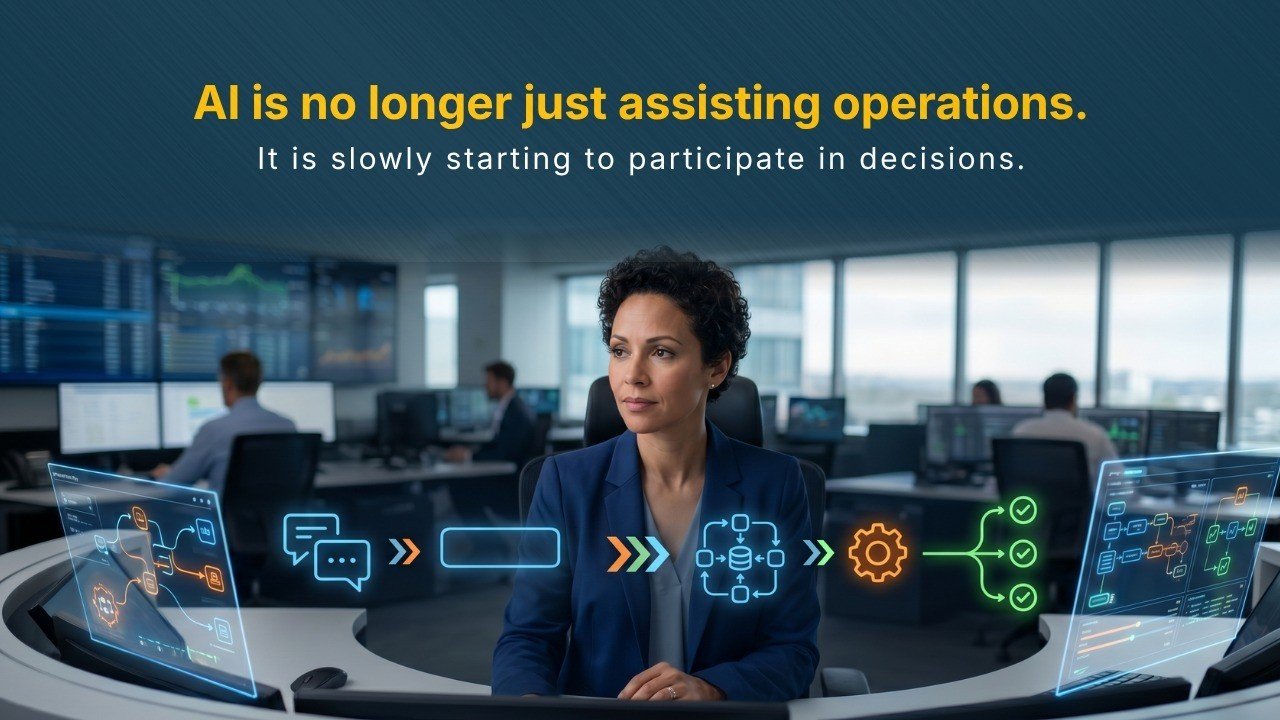
There is a noticeable shift happening inside operational environments right now.
For the last couple of years, most AI conversations were still centered around assistance: helping teams write faster, summarize faster, search faster, respond faster.
Useful improvements, definitely. But still largely human-led workflows with AI sitting beside the operator.
What feels different now is that we are beginning to see AI systems that do not just assist work, but increasingly participate in operational decision-making itself.
That changes the nature of the conversation entirely.
In many operational setups, the question is no longer: “How can AI improve productivity?”
It is slowly becoming: “What decisions are we comfortable allowing AI systems to make autonomously?”
And in my experience, that is where the real complexity begins.
A few patterns have stood out to me while observing how organizations are approaching this transition.
1. What we are increasingly seeing is that AI capability is not really the biggest constraint. Operational trust is.
The technology itself is evolving quickly. The harder part is deciding where autonomy is acceptable.
In many teams, even basic operational reporting is still evolving from spreadsheet-driven tracking towards structured Business Intelligence systems.
And now, on top of that transition, we are beginning to introduce autonomous AI layers expected to interpret, recommend, and sometimes even trigger actions independently.
That is a far bigger operational leap than it appears on the surface.
Because once AI starts participating in live operational workflows, the messiness of real systems becomes much more visible.
Operational environments are rarely as clean or predictable as process diagrams suggest. Exceptions exist everywhere:
- edge cases
- incomplete data
- relationship dependencies
- context-heavy judgment calls
- trade-offs that are difficult to codify cleanly
This is why many AI deployments still remain in “copilot mode.”
The system can recommend but humans still want to validate.
And honestly, that hesitation is understandable. In operations, even small incorrect decisions compound quickly.
2. The most valuable AI use cases are often surprisingly unglamorous
A lot of external AI conversation still focuses on dramatic transformation narratives.
But internally, many meaningful operational gains are coming from much quieter improvements:
- routing work faster
- identifying escalation risk earlier
- reducing coordination overhead
- summarizing fragmented information
- improving transition continuity
- surfacing operational anomalies before they become visible downstream
None of these sound revolutionary individually. But collectively, they remove enormous amounts of friction from operational systems.
That matters more than most people initially realise.
Because operational efficiency is often shaped by hundreds of small delays rather than one large problem.
3. AI adoption exposes process weakness very quickly
One interesting thing starts happening once autonomous workflows begin entering real operational environments.
They suddenly discover how many operational decisions were previously dependent on human interpretation rather than system clarity.
The AI is not confused because the technology is immature. Very often, the underlying process itself was never fully standardized to begin with.
In some ways, AI becomes an operational mirror.
It exposes ambiguity teams had unknowingly learned to work around manually for years.
4. Governance becomes operational, not just technical
A lot of AI governance discussions still sit heavily inside legal, compliance, or technology teams. But once AI starts participating in operational decisions, governance becomes a daily operational reality.
Questions start becoming far more practical:
- Who overrides the system?
- What level of confidence triggers automation?
- How are exceptions handled?
- What happens when business context changes suddenly?
- Who remains accountable when decisions are AI-assisted? s
These are not future-state questions anymore. Many teams are already navigating them quietly.
The Real Shift Is Operational, Not Technological
What I suspect will matter more over the next few years is not simply AI adoption itself.
It will be operational judgment around where autonomy genuinely creates value and where human involvement still matters deeply. Because not every workflow benefits equally from automation. And not every operational decision should become autonomous simply because it can.
In the end, the transition from copilot to autopilot is probably less about technology maturity and more about organizational maturity.
The companies that navigate this well will likely be the ones that treat AI neither as hype nor threat.
But simply as another operational system that needs: clarity, accountability, human judgment, and thoughtful integration into real work.
#AIInOperations #OperationalExcellence #AITransformation #SystemsThinking #FutureOfWork