
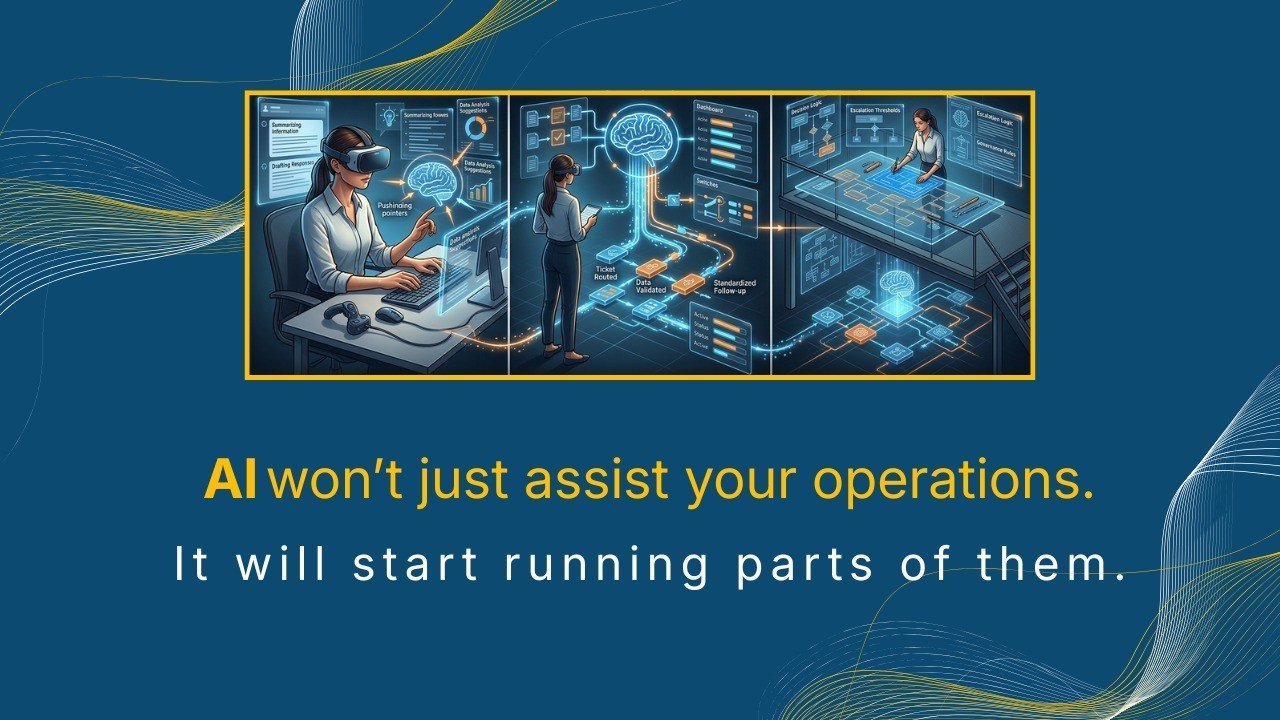
For the last couple of years, most organizations have experimented with AI as a copilot something that assists, suggests, and accelerates. It has been useful, but still safely within human control.
What’s changing now is more fundamental.
We are moving from AI that supports decisions to AI that can execute them in real operational workflows where tasks are triggered, actions are taken, and outcomes are delivered with minimal human intervention.
That shift from copilot to autopilot is where the real opportunity, and risk, sits.
Where Most Teams Are Today
In many setups, AI is layered on top of existing workflows:
· Drafting responses
· Summarizing information
· Assisting analysis
Useful, but incremental.
The underlying operating model remains unchanged. Humans still interpret, decide, and execute. AI simply makes each step faster.
The limitation becomes clear over time. You get efficiency gains, but not structural change.
What Changes with Agents
AI agents don’t just assist they act within defined boundaries.
They can:
· Monitor signals continuously
· Trigger workflows based on conditions
· Execute multi-step actions across systems
This is where operations start to shift. But the mistake many teams make is trying to “deploy agents” without rethinking how decisions are structured.
What Actually Works
From what I have seen, successful adoption is less about technology and more about how clearly the system is defined.
1. Start with bounded use cases, not ambition
The temptation is to automate end-to-end workflows. That usually fails.
Instead, identify:
· High-frequency, low-ambiguity tasks
· Clear decision rules
· Limited downside if wrong
For example:
Ticket routing, data validation, standardized follow-ups; agents perform best where judgment is minimal and context is stable.
2. Separate decision logic from execution
One practical approach is to define:
· Decision rules (what should happen)
· Execution layer (how it happens)
Agents can then operate on the execution side, while humans retain control over evolving rules. This prevents over-reliance and makes the system easier to adjust.
3. Build human override into the system
Autonomy without oversight creates risk.
Effective setups include:
· Escalation thresholds
· Confidence-based handoffs
· Clear rollback mechanisms
Not everything should be automated. But everything automated should be reversible.
4. Treat governance as design, not control
Most teams think of governance as restriction. In reality, it’s what enables scale.
Define upfront:
· Where agents are allowed to act
· What data they can access
· What decisions require human validation
When this is clear, adoption becomes faster not slower.
The Real Shift
The biggest misconception is that AI agents replace operators. In practice, they change what operators spend time on.
· Less manual execution
· More system design
· More exception handling
Which leads to a different kind of leverage.
The One Thing That Matters
If there’s one place to focus, it’s this:
Don’t start with AI. Start with how decisions are made. Because agents don’t fix broken decision systems. They amplify them.
When decision logic is unclear, automation increases inconsistency. When it’s well-defined, automation increases scale.
This is why some teams see meaningful gains, while others see limited impact despite similar tools.
The difference isn’t capability. It’s clarity.
AI in operations is not about moving faster. It’s about deciding better, and then letting systems execute with confidence.
That’s what takes you from assistance to autonomy.
#AIOperations #DigitalTransformation #FutureOfWork #AutomationStrategy #EnterpriseAI