
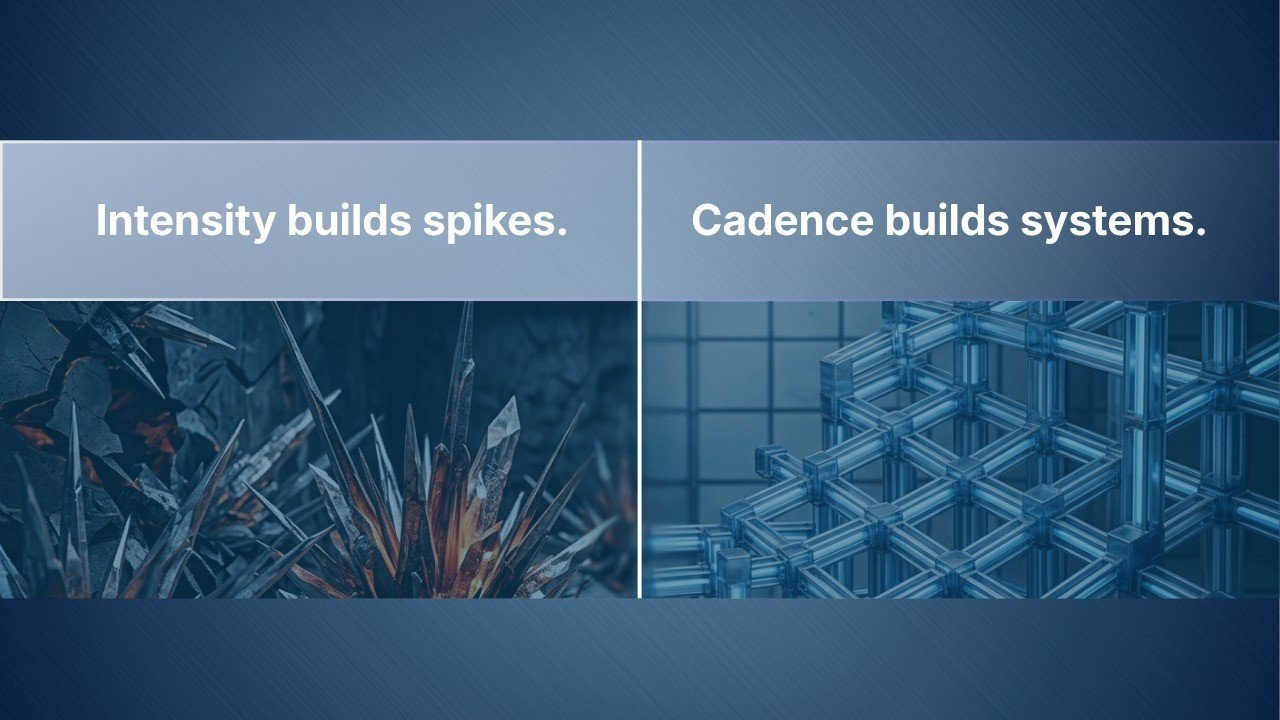
In most organizations, performance still depends on bursts of effort.
A big push before quarter-end. Late nights before a launch. Firefighting when something breaks.
I believe, it works only temporarily.
Over time, intensity creates volatility:
Teams burn out
Problems surface too late
Execution becomes personality-driven
What I have consistently seen is this: strong operators don’t rely on intensity. They design rhythm.
Because sustainable performance is not about how hard you push. It’s about how consistently the system moves.
The Shift: From Effort to Cadence
Operational rhythm is often misunderstood as “more meetings.”
In reality, it’s about creating predictable cycles of visibility, decision-making, and accountability.
A well-designed cadence does three things:
- Surfaces issues early
- Forces decision velocity
- Aligns teams without constant escalation
Without cadence, everything feels urgent. With cadence, most things become manageable.
1. Daily Rhythm: Clarity, Not Reporting
Daily huddles are where things often go wrong.
They turn into status updates. They should be decision-enabling touchpoints.
A strong daily rhythm answers just three questions:
- What is off track today?
- What decisions are blocked?
- What needs escalation within 24 hours?
That’s it. No long updates. No storytelling.
The goal isn’t information sharing. It’s friction removal.
Well-run daily huddles are short (10-15 minutes), focused, and slightly uncomfortable because they force clarity.
2. Weekly Rhythm: Accountability in Motion
If daily is about immediacy, weekly is about ownership. This is where most execution systems quietly break.
Weekly reviews should:
- Track a small set of committed metrics (not dashboards with 20 KPIs)
- Tie every metric to a clear owner
- Focus on variance (plan vs actual)
- Force corrective actions with timelines
The discipline here is simple, but rare:
No metric without an owner. No deviation without an action.
When done right, weekly reviews reduce surprises. When done poorly, they become performative updates.
3. Monthly Rhythm: Strategic Alignment
Monthly reviews are not extended weekly reviews.
They serve a different purpose:
- Reassessing priorities
- Evaluating structural issues
- Aligning cross-functional dependencies
- Making resource allocation decisions
This is where operators step slightly out of execution and ask:
Are we solving the right problems?
Where are we structurally constrained?
What needs to change, not just improve?
Monthly cadence prevents teams from becoming efficient at the wrong things.
4. The Design Principle Most Miss
This is where cadence either works or collapses.
Each layer must serve a distinct purpose:
Daily – Execution friction Weekly – Performance accountability Monthly – Strategic direction
When these blur:
- Daily becomes noisy
- Weekly becomes repetitive
- Monthly becomes redundant
Clarity of intent is what makes cadence actually work.
5. Cadence Creates Cultural Signals
This part is often underestimated.
Cadence is not just operational. It becomes cultural infrastructure.
What you review frequently signals what matters.
- If metrics are reviewed weekly, they matter
- If decisions are delayed, accountability weakens
- If leaders show up prepared, teams follow
Over time, cadence shapes:
- Decision speed
- Ownership behavior
- Cross-functional trust
Culture is not declared. It gets reinforced through rhythm.
6. The Hidden Advantage: Reduced Dependency on Individuals
Organizations driven by intensity depend on heroes. While organizations driven by cadence depend on systems.
That’s the real shift.
- Execution becomes predictable
- Knowledge becomes distributed
- Performance becomes repeatable
And most importantly:
You don’t need exceptional effort to get consistent results.
The Operator’s Reality
Cadence is not glamorous work. It requires discipline, consistency, and repetition.
But that’s exactly why it works.
Because while others are reacting, you are already reviewing. While others are escalating, you are already aligned. While others are pushing harder, your system is simply moving better.
If you are building or running operations, ask yourself:
Are we relying on intensity to deliver outcomes? Or have we designed a rhythm that makes performance inevitable?
That answer usually defines scale.
#OperationalExcellence #Leadership #Execution #BusinessOperations #Management