
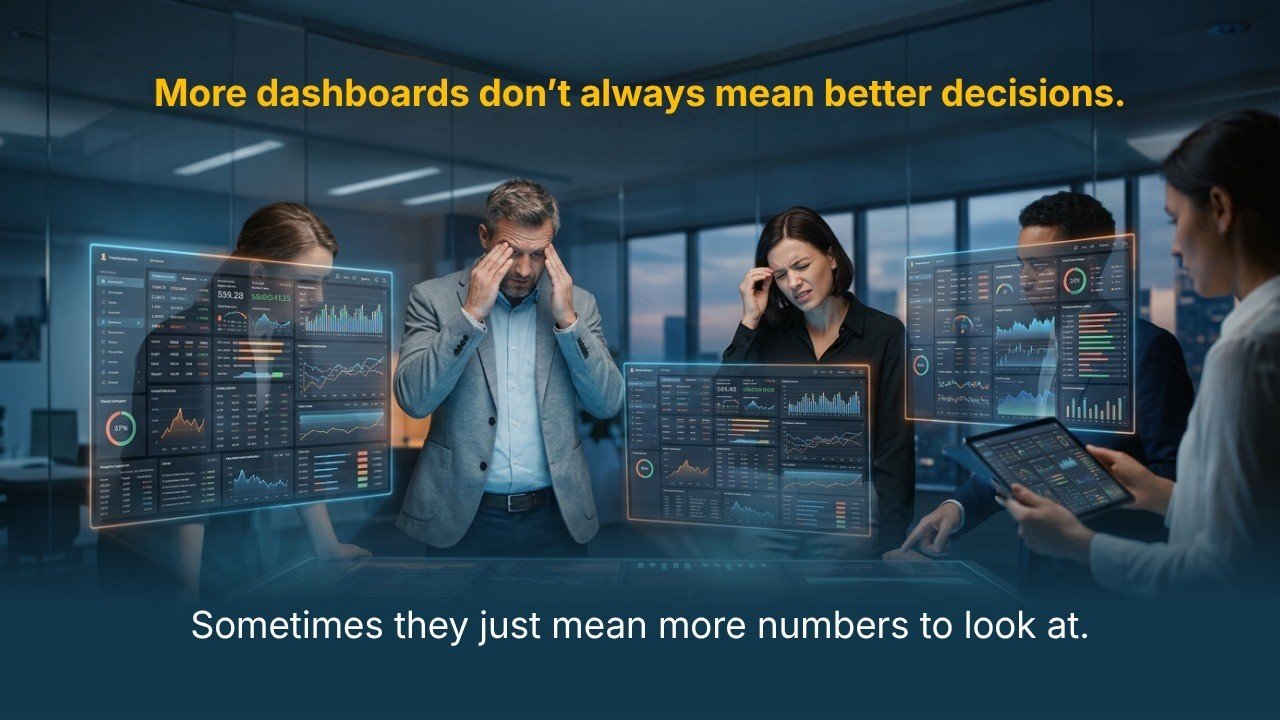
I have been thinking lately about how data shows up inside operational systems. For a long time, I assumed that better visibility naturally leads to better decisions.
More dashboards. More tracking. More real-time metrics.
It felt intuitive.
If we can see more, we should be able to act better. But the more I sit through operational reviews, the more I am noticing that visibility and clarity are not always the same thing.
A team can have every metric available and still struggle to answer a fairly basic question:
So what do we do next?
That feels like one of the more interesting operational gaps today.
We have become very good at collecting information.
We are still figuring out how to make that information genuinely useful for decision-making.
I don’t think the problem is lack of data. If anything, it is usually the opposite.
Sometimes there is so much to look at that the signal gets buried inside the noise.
Sharing a few things, I am beginning to notice:
1. Not every metric deserves equal attention
Most dashboards seem to expand over time.
A few useful metrics get added. Then more requests come in. And then every function wants visibility into something.
Before long, there are 25–30 numbers on the screen and everyone is scanning everything.
What I am starting to realize is that operational clarity often comes from reduction, not addition.
The useful here question seems to be:
Which of these numbers would actually change a decision?
Some metrics tell us whether the system is healthy. Some tell us whether performance is improving. And some directly help decide what action to take next.
That third category feels far more valuable than we often acknowledge.
2. Observation without action creates a false sense of progress
This is something I have seen often.
Sometimes when a metric changes:
- Response time dips.
- Drop-offs increase.
- Completion rates slow.
The team notices it. There is discussion. Everyone acknowledges the shift. And then somehow the meeting moves on.
Data becomes useful only when it creates movement. What seems to help is a very simple rhythm:
Start by observing, then understand, decide, assign, and revisit.
Just enough structure to ensure the conversation does not stop at noticing. Because visibility without follow-through can create the illusion of control.
3. Data only works when more people can engage with it
This one feels easy to underestimate.
We often think better analytics means stronger analyst capability.
That matters.
But operational maturity probably depends just as much on whether non-technical teams can engage with the data meaningfully.
Some of the strongest operational judgment I have seen has come from managers who were not deeply analytical in the technical sense. They were simply asking the right questions:
What changed? Is this normal variation? What decision does this support?
That kind of shared data fluency seems to matter more than complex reporting.
Final thought
You need to view dashboards differently. Not as decision-making tools by themselves. But as inputs into better operational conversations.
The real value is not in seeing more. It is in helping teams move from insight to action with greater confidence.
And maybe that is the shift that matters most:
Not building better dashboards. Building better decision systems around them.
#DataDrivenOperations #OperationalExcellence #DecisionMaking #StartupOperations #AnalyticsLeadership