
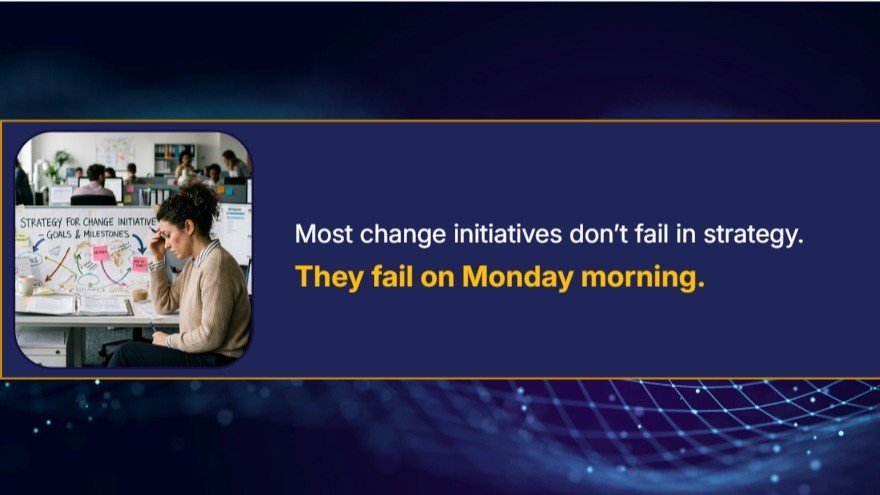
Change rarely fails because the plan is wrong. It fails in the weeks after launch, when execution meets reality.
Strategies can look perfect on paper but humans rarely are. Success in change depends on the human system: habits, decisions, incentives, and culture. Transformation isn’t about heroics. It’s about discipline, clarity, and consistent action.
Here’s a practical playbook I have seen work repeatedly.
1) Treat Launch Day as Operational, Not Symbolic
Change is not a press release or an announcement. It is about continuity and clarity.
Ask:
- Can teams continue to perform without friction?
- Do people know who has decision authority now?
- Are escalation paths clear?
If the answer to any of these is “maybe,” execution will stall. Operational clarity reduces anxiety and anxiety is the silent killer of change.
2) Build a Visible Change Backbone
Every successful transformation has a spine:
- One accountable change owner
- A short list of measurable priorities
- Regular review cadence with escalation discipline
Without a backbone, change is just good intentions. What gets measured and reviewed gets done.
3) Capture Early Wins Publicly
Early successes are critical to momentum. Targets that live only in decks rarely inspire belief.
Translate initiatives into:
- Named owners
- Milestones with clear deadlines
- Visible progress tracking
Early wins build confidence and belief in the change momentum becomes a strategic asset.
4) Communicate Decisions, Not Just Narratives
Change fatigue comes from ambiguity, not workload.
Teams need clarity:
- What has changed
- What remains the same
- Who now makes decisions
Clear, repeated communication collapses uncertainty and accelerates execution.
5) Make Culture Operational, Not Theoretical
Culture isn’t posters or slogans, it’s behavior.
It shows up in:
- Meeting cadence
- Decision-making behavior
- Accountability norms
Leaders must model the desired culture. People follow actions, not messages.
6) Prioritize Ruthlessly
The biggest mistake is trying to change everything at once.
Instead:
- Identify 3–5 critical initiatives that drive real value
- Freeze non-essential changes
- Sequence the rest
Focus and prioritization protect momentum and reduce burnout.
Practical Change Management Checklist:
- Define operational continuity explicitly for launch
- Assign one accountable change owner
- Convert strategic goals into actionable execution plans
- Communicate decisions regularly and clearly
- Model culture through consistent behavior
- Protect focus with disciplined prioritization
Change is rarely glamorous. It’s messy, human, and iterative. But with clarity, cadence, accountability, and focus, organizations stop being fragile, they become resilient.
#ChangeManagement #LeadershipExecution #OrganizationalTransformation #OperationalExcellence #PeopleFirst
(A practical guide for what actually makes transformations work)
Change rarely fails because the plan is wrong. It fails in the weeks after launch, when execution meets reality.
Strategies can look perfect on paper but humans rarely are. Success in change depends on the human system: habits, decisions, incentives, and culture. Transformation isn’t about heroics. It’s about discipline, clarity, and consistent action.
Here’s a practical playbook I have seen work repeatedly.
1) Treat Launch Day as Operational, Not Symbolic
Change is not a press release or an announcement. It is about continuity and clarity.
Ask:
Can teams continue to perform without friction?
Do people know who has decision authority now?
Are escalation paths clear?
If the answer to any of these is “maybe,” execution will stall. Operational clarity reduces anxiety and anxiety is the silent killer of change.
2) Build a Visible Change Backbone
Every successful transformation has a spine:
One accountable change owner
A short list of measurable priorities
Regular review cadence with escalation discipline
Without a backbone, change is just good intentions. What gets measured and reviewed gets done.
3) Capture Early Wins Publicly
Early successes are critical to momentum. Targets that live only in decks rarely inspire belief.
Translate initiatives into:
Named owners
Milestones with clear deadlines
Visible progress tracking
Early wins build confidence and belief in the change momentum becomes a strategic asset.
4) Communicate Decisions, Not Just Narratives
Change fatigue comes from ambiguity, not workload.
Teams need clarity:
What has changed
What remains the same
Who now makes decisions
Clear, repeated communication collapses uncertainty and accelerates execution.
5) Make Culture Operational, Not Theoretical
Culture isn’t posters or slogans, it’s behavior.
It shows up in:
Meeting cadence
Decision-making behavior
Accountability norms
Leaders must model the desired culture. People follow actions, not messages.
6) Prioritize Ruthlessly
The biggest mistake is trying to change everything at once.
Instead:
Identify 3–5 critical initiatives that drive real value
Freeze non-essential changes
Sequence the rest
Focus and prioritization protect momentum and reduce burnout.
Practical Change Management Checklist:
Define operational continuity explicitly for launch
Assign one accountable change owner
Convert strategic goals into actionable execution plans
Communicate decisions regularly and clearly
Model culture through consistent behavior
Protect focus with disciplined prioritization
Change is rarely glamorous. It’s messy, human, and iterative. But with clarity, cadence, accountability, and focus, organizations stop being fragile, they become resilient.