
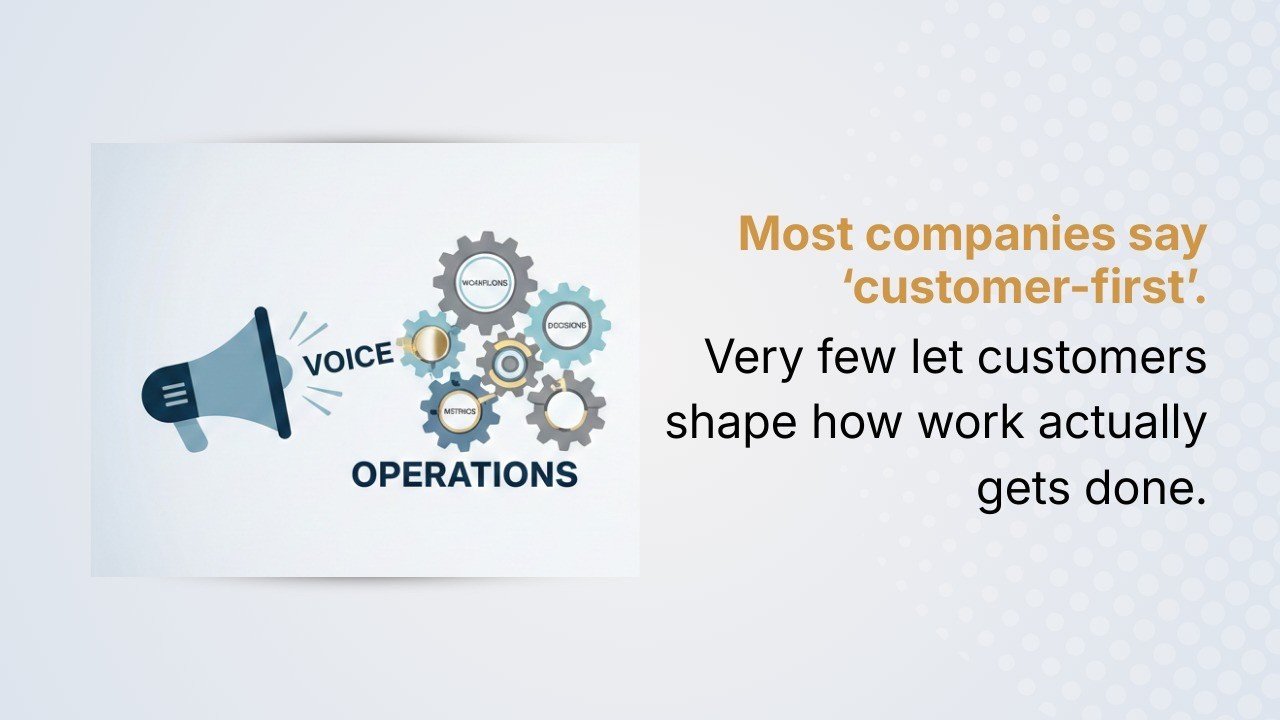
Customer-centricity has become one of the most overused phrases in the business world. It appears in vision decks, town halls, and brand campaigns. Yet when you step into day-to-day operations, decisions are still driven by internal convenience, legacy processes, or quarterly targets, rather than by real customer insights.
The gap isn’t intended. Most leaders genuinely care about customers. The gap is execution.
True customer-centricity doesn’t live in slogans. It lives in how work flows, how decisions are made, and what teams are measured on.
The mistake most organizations make
Customer success is often treated as a function limited to sales, support, or account management. As a result, the rest of the organization assumes that understanding the customer is someone else’s responsibility.
But customers don’t experience internal teams. They experience handoffs, delays, confusion, and friction as they move through the value chain.
When operators don’t own customer insight, customer-centricity stays superficial, which is visible in language but absent in execution.
A real moment that changed how I saw this
In one of my earlier roles, we were facing rising churn despite healthy sales numbers. The instinctive reaction was to push harder on onboarding and support scripts. Instead, we mapped the end-to-end customer journey with frontline teams.
The insight wasn’t dramatic but it was decisive.
Customers weren’t leaving because of product issues. They were leaving because internal approvals created a 7–10 day gap with no updates or communication during a critical phase.
No amount of empathy training could fix that. What it really needed was a change in how the work flowed.
Once approvals were simplified and ownership clarified, churn dropped. It was not because we “listened harder,” but because we changed how work moved.
That’s the difference between hearing customers and operationalizing them.
A pragmatic roadmap to operational customer centricity
1. Move from feedback collection to feedback ownership
Most companies collect feedback. Few decide who acts on it.
Customer insights must be owned by operators who can change:
- workflows
- decision rights
- escalation paths
If feedback has no operational owner, it becomes noise.
2. Embed Voice of Customer into operating rhythms
Customer signals shouldn’t appear only in quarterly reviews.
Practical integration looks like:
- VOC metrics reviewed in weekly ops meetings
- customer quotes alongside dashboards
- journey pain points mapped to process KPIs
When customer data shows up where decisions happen, behavior changes.
3. Design closed-loop systems, not surveys
The goal isn’t “more feedback.” The goal is shorter loops.
A closed loop answers three questions:
- What did the customer experience?
- What operational change does this require?
- Who confirms the fix worked?
Without the loop, surveys become performative.
4. Align metrics with customer outcomes
Teams optimise what they are measured on.
Customer-centric operators link cycle time to customer effort, first-time-right execution to trust, and handoff quality to long-term retention. When internal efficiency improves customer experience, alignment happens naturally.
5. Treat customer insight as a growth lever, not a risk signal
High-performing organizations don’t look at customer feedback only to prevent churn. They use it to:
- identify advocacy moments
- design referral triggers
- create organic differentiation
Satisfied customers don’t just stay; they drive growth through referrals and advocacy.
Why this actually drives results
When customer insight is woven into operations:
- Retention improves because friction is removed, not explained away
- Churn drops because root causes are fixed upstream
- Differentiation emerges through consistency, not marketing
Customer obsession becomes scalable, not heroic.
The real shift to make
Customer-centricity isn’t about being nicer. It’s about being structurally responsive.
The organizations that win don’t ask, “Do we care about customers?” They ask, “Where in our system are customers shaping decisions today?”
That’s where intent ends and real advantage begins.
#CustomerCentricity #OperationsLeadership #VoiceOfCustomer #CustomerExperience #BusinessExecution