
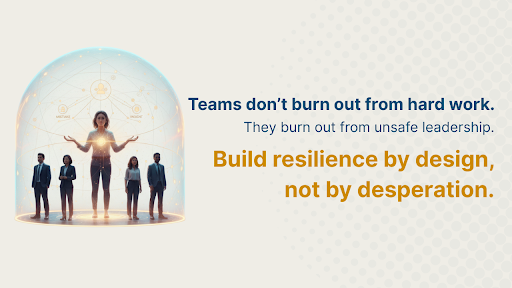
Most people talk about resilience as a personality trait, something you are either born with or build through enough hardship. But the longer I have led teams through volatility, be it business scenario swings, unexpected restructures, process changes, or sudden strategic pivots, the more I realised that:
Individual resilience is overrated. Organisational resilience is what truly keeps you alive.
In every high-pressure cycle, I noticed a pattern. The teams that bounced back fastest were never the ones with the “toughest” individuals. They were the ones with the safest environments, the clearest priorities, and leaders who refused to lead from adrenaline.
Let me explain.
Lesson 1: Teams break when they are scared, not when they are stretched
A few years ago, during a major restructuring, my team was operating with half the resources but twice the expectations. The real challenge wasn’t workload, it was fear. Fear of job loss, fear of making the wrong move, fear of being invisible.
Productivity dipped not because people were incapable, but because psychological safety collapsed.
I learned quickly that resilience does not start with motivation. It starts with removing fear from the system.
Practical ways to create safety:
- Replace “What went wrong?” with “What could we learn and be better prepared in the future?”
- Normalise sharing blockers rather than hiding them, and make communication part of the solution.
- Make uncertainty discussable, not taboo
- Give people clarity on what won’t change, not just what will
When fear drops, adaptability rises. Every single time.
Lesson 2: A resilient team is a learning system, not a group of high performers
High performers collapse when success becomes dependent on perfection. Resilient teams, on the other hand, build processes that convert failure into fuel.
During a period of rapid product changes, my team was putting out fires daily. Initially, the cycle exhausted them until we introduced a simple rhythm:
Weekly “Update Reviews” instead of post-mortems. Not: “Who messed up?” But: “What did this week teach us about our blind spots, our assumptions, or our speed?”
Within months, the team stopped fearing mistakes. They started anticipating them, adjusting earlier, and collaborating better. That is resilience in motion.
To build a learning culture:
- Debrief small issues before they become big
- Track learnings with the same seriousness as metrics
- Celebrate adaptability as much as achievement
Resilience grows when learning becomes habitual.
Lesson 3: The biggest lie in leadership is that resilience comes from being ‘always on’
I used to think the best leaders were the ones who stayed online the longest, picked up every crisis at 11 pm, and stretched themselves thin to “hold the fort”.
I was wrong.
Exhausted leaders create exhausted teams. What teams need is not a hero. They need a steady centre. And this ‘always on’ becomes part of culture, meaning the exhausted leader has now become part of the problem rather than part of the solution.
Your calm becomes their confidence. Your clarity becomes their direction. Your boundaries become their permission to rest.
To build sustainable resilience:
- Set work-rest rhythms (and model them yourself)
- Plan slow-down weeks after intense cycles
- Protect deep work time for yourself and your team
- Build redundancy as resilience collapses when knowledge sits with one person
High performance during turbulence is only possible when recovery is built into the system.
Resilient organisations are not born. They are built, intentionally, patiently, repeatedly.
You do not build resilience by pushing people harder. You build it by designing environments that stay stable even when the world is unstable.
If there is one thing I have learned, it is this:
Resilience is not how teams survive chaos. It is how they stay human inside it.
#LeadershipClarity #ResilientTeams #OperationalExcellence #StrategicExecution #LeadingThroughChange