
Over the last two years, I have noticed an interesting pattern. It isn’t the smartest teams that move fastest. Rather it’s the best structured ones.
In review meetings, the same question keeps coming up: “We have the people. We have the tools. So why are we still slow?”
More often than not, the answer is almost invisible: the structure is working against momentum.
Traditional hierarchies were built for a predictable world, stable markets, clear roles, linear processes. 2025 has been the opposite. The market shifts happened mid-quarter. Customers talk faster than companies can respond. Job titles barely capture what people can actually do.
That’s why organizational design is no longer an HR exercise. It’s a competitive advantage.
The Silent Cost of Rigid Departments
Most businesses still operate with departments because “that’s how it’s always been done.” But as roles become fluid and customers expect faster execution, departments often create three issues:
- Misalignment of goals – Marketing optimizes for awareness, operations chases efficiency, product wants innovation. Each team pushes in a different direction.
- Decision delays – Approvals and escalations make every step feel heavier than it should.
- Siloed creativity – Good ideas exist, but they stay trapped in the department that formed them.
What Adaptive Teams Are Doing Differently
The shift is already happening. Ambitious operators are moving away from control-based hierarchies toward adaptive, fluid architectures built for speed and learning.
1. Agile Pods – Built Around Problems, Not Departments
In a pod (a self-contained team handling a problem end-to-end), everything needed to solve a problem sits within one team like strategy, execution and feedback.
So, there is nothing like escalation, chasing signatures, or waiting for a department to “approve.” There is better clarity and the ability to move fast.
When leaders adopt pods, they often see decisions happening faster and ownership rising within just a few weeks.
2. Skill-Based Teaming – Talent Without Labels
In this model, people contribute based on skills and not just their job title. A salesperson may support UX research or a designer may contribute to product strategy. Teams rotate based on capability, not hierarchy.
When this happens, talent becomes visible and human potential stops getting boxed in.
3. Networked Organization – A Living System
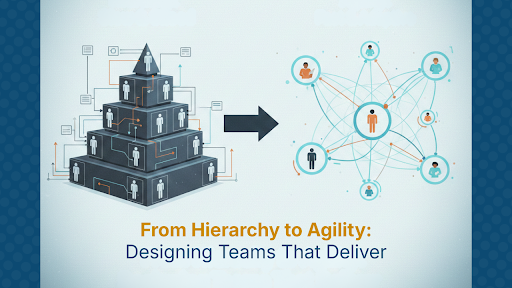
In a network (teams connected like a web, not stacked like a pyramid), information flows directly between teams. Everyone knows what’s happening, and no one person slows things down.
It doesn’t just improve speed, it also builds adaptability and resilience when things change.
How to Begin – A Practical Starting Point
Restructuring doesn’t need to start with a big announcement. It can start with self-awareness.
Ask: Where do decisions get stuck?
This reveals the structural friction points, the places where speed silently dies.
Ask: What skills are currently under-used?
This often exposes hidden capability, talent sitting beyond its job description.
Ask: Which problems keep repeating?
Patterns help define natural pod structures, clusters of work that deserve a dedicated team.
Ask: Who has deep context but no authority?
This signals lost momentum, competence without decision power.
The Future Isn’t Flat. It’s Dynamic.
People don’t resist change. They resist confusion. Adaptive structures don’t promise chaos, they promise clarity. They give teams permission to move, learn, contribute, and grow beyond their job title.
In the end, momentum rarely comes from motivation. It comes from design.
And the leaders who understand that won’t just manage better. They will build organizations that evolve faster than the market demands.
#organizationaldesign #leadership #agileteams #businessspeed #adaptiveorganization