
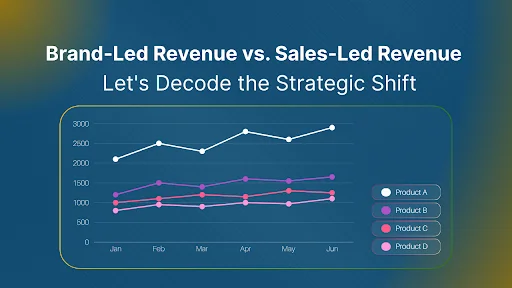
A few years ago, I was part of a business review where the sales team proudly presented their business numbers. The charts looked good as the leads were up, conversions steady, and revenue targets were met.
But there was a question I couldn’t shake off: Why were our customer acquisition costs rising every quarter despite higher sales?
We discussed the issue and realised they were growing through effort, not momentum. What does that mean?
Every period required the same hard push to hit targets, no carryover, no compounding effect. Growth wasn’t building on itself; it was restarting each time.
And that’s the difference between sales-led and brand-led revenue.
From Push to Pull
In a sales-led model, growth depends on how much you chase. More calls, more campaigns, more negotiations. It’s effort-intensive, pipeline-heavy, and linear.
A brand-led model, on the other hand, builds pull. Customers come to you already trusting your intent, credibility, and capability. The brand does the heavy lifting long before the salesperson enters the room.
One drives transactions. The other drives belief.
Why the Shift Is Happening
The market has changed, not just in technology but in psychology. Today’s customers do their homework. They read, compare, and form opinions before meeting you.
Recent 2025 data from B2B and Consumer Tech sectors confirms this shift:
- Bottom-up adoption is now more common than top-down enterprise buying.
- Time-to-value has reduced because users self-onboard faster.
- Inbound leads from brand content convert at 2x the rate of cold outreach.
In short, buyers trust what they discover more than what they are told.
The Hybrid Path
This doesn’t mean sales-led models are obsolete. In fact, the best organisations now run a hybrid system: The brand creates awareness and trust, The sales team converts it into partnerships
When I assess revenue engines, I look for three signs:
- Are most leads coming from interest or outreach?
- Is content driving education and trust before first contact?
- Are customers buying because of brand credibility or discounts and deals?
When the second column starts showing strength, it’s clear that the brand is selling.
Brand as an Economic Moat
A strong brand does more than attract customers. It compounds growth. It lowers acquisition costs, reduces friction in the sales process, and builds loyalty that no pricing tactic can replicate.
In a world where competitors can copy your product or undercut your price, brand becomes the moat, built on trust, reputation, and clarity.
That’s why leading operators today are rebalancing their investments: less in quarterly hustle, more in long-term credibility.
Takeaway
Brand-led revenue is not anti-sales. It’s sales, evolved where reputation sells faster than outreach.
When your brand educates, your sales team doesn’t have to convince. When your brand builds trust, your pipeline compounds. And when your customers believe in your intent, they sell for you.
The real shift isn’t just in strategy, it’s in mindset. From “How do we sell more?” to “How do we become worth buying from?”
That’s where the next wave of sustainable growth will come from.
#BrandStrategy #RevenueLeadership #GrowthMindset #B2BMarketing #OperatorInsights