
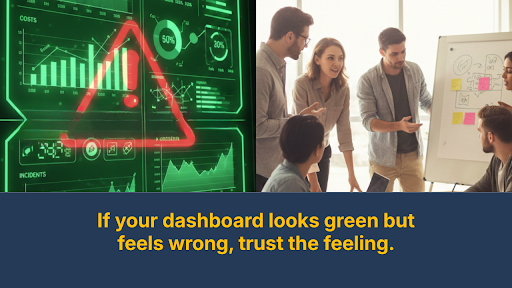
I clearly remember a review, almost two years back, where every number was green. Revenue was up. SLAs were met. Utilisation looked healthy.
But despite it all, something felt off.
Teams were stretched. Decisions were slow. Firefighting had quietly become normal. The dashboard said everything was fine. However, the floor told a very different story.
It was a simple but uncomfortable lesson we learnt from that event: Dashboards don’t fail because of bad data. They fail because they tell the wrong story.
Since then, I have spent a lot of time thinking about dashboards not as reporting tools, but as decision systems. When designed well, they reduce confusion, align teams, and surface risk early. When designed poorly, they create false confidence and delay action.
Why Most Dashboards Don’t Drive Action
Most dashboards are built with good intent, track everything, show transparency, avoid missing signals. In reality, they do the opposite.
Common patterns I keep seeing:
- Too many KPIs, no clear priorities
- Metrics that look impressive but don’t change behaviour
- Weekly reviews where numbers are read, not discussed
- Leaders asking for “more data” instead of better questions
At scale, dashboards should not explain the past. They should shape the next decision.
Here are the steps that turn dashboards from reports into decision tools:
Step 1: Choose KPIs that reflect decisions, not departments
A useful KPI answers a specific question:
What decision will this metric influence?
If there’s no clear decision, the KPI is noise. Strong operational dashboards usually include:
- Outcome metrics (what the customer or P&L feels)
- Leading indicators (what will break next)
- Capacity signals (where pressure is building)
What they avoid:
- Vanity metrics
- Department-specific success measures
- Lagging indicators presented without context
Good operators resist the urge to track everything. They design for clarity under pressure.
Step 2: Design dashboards for rhythm, not reporting
Dashboards should match how the business runs.
A few principles that changed how I design them:
- Daily dashboards surface exceptions, not summaries
- Weekly dashboards show trend and drift, not snapshots
- Monthly dashboards connect operations to economics
If the dashboard doesn’t fit the operating rhythm, it won’t get used no matter how accurate it is.
Step 3: Visuals should reduce thinking, not demand it
The best dashboards feel almost boring. That’s intentional.
Effective visualisation:
- Highlights deviation, not averages
- Makes anomalies obvious within seconds
- Avoids over-designed charts that slow interpretation
If someone has to ask, “What am I supposed to notice here?”, the design has already failed.
Step 4: Build anomaly detection into the system
Most operational failures don’t come from sudden collapse. They come from small deviations ignored for too long.
Dashboards should surface:
- Variance beyond normal operating ranges
- Trend breaks, not just threshold breaches
- Leading signals before customer impact
This shifts teams from reacting to incidents to managing stability.
Step 5: Translate dashboards into executive narratives
Senior leaders don’t need more charts. They need directional clarity.
The most effective dashboards I have seen answer three questions clearly:
- What’s changing?
- Why does it matter now?
- What decision is required?
When dashboards tell a coherent story, alignment improves naturally. Decisions accelerate. Escalations become precise instead of emotional.
The Real Discipline
Dashboard discipline isn’t about tools or software. It’s about restraint.
Knowing what not to show. Knowing when a metric has outlived its usefulness. Knowing that clarity beats completeness every time.
When dashboards are designed as storytelling systems, data stops being passive. It starts guiding behaviour.
And that’s when numbers turn into an operating advantage, consistently and at scale.
#OperationsStrategy #DataDrivenLeadership #ScalingSystems #OperationalExcellence #BusinessOperations