
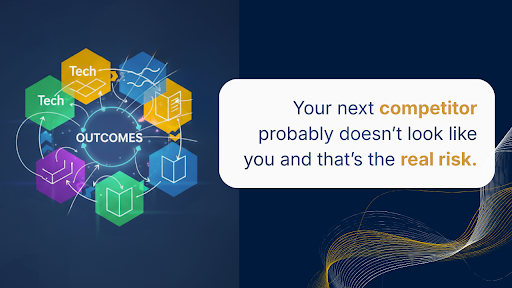
For decades, competitive strategy was built on clear industry boundaries. You knew who your competitors were, where threats would come from, and how differentiation worked. That mental model is gradually breaking.
In 2025, competition no longer announces itself neatly.
EdTech companies borrow SaaS pricing models. SaaS platforms behave like marketplaces. Traditional service businesses compete on experience, not expertise.
The real disruption isn’t technology. It’s convergence.
A moment that forced me to rethink competition.
On one occasion, we spent months tracking a familiar competitor: pricing moves, feature launches, hiring patterns, the usual playbook. Meanwhile, churn started creeping up from an unexpected segment.
When we finally dug deeper, the cause wasn’t our known rival. It was a company from a completely different sector offering a simpler, faster outcome by repackaging capabilities we assumed were “industry-specific.”
They weren’t better at what we did. They reframed the problem customers were trying to solve.
That’s when it became clear: we weren’t losing to competition. We were losing to convergence.
Why traditional competitive thinking fails now
Most competitive strategies still assume:
- clear industry lines
- direct substitutes
- head-to-head battles
But customers don’t buy industries. They buy outcomes.
When outcomes matter more than categories, competitors can come from anywhere.
The shift operators must make
Stop asking: “Who looks like us?” Start asking: “Who solves the same customer problem differently?”
That question changes everything.
How to think about competition in a converging world
1. Scan sideways, not just forward
Competitive intelligence can’t stay vertical. Operators need to look across:
- Adjacent industries
- Business models customers already trust
- Companies winning on speed, simplicity, or access
Often, the best strategic insight comes from places that feel “irrelevant”, until they aren’t.
2. Borrow, don’t benchmark
In convergence, advantage comes from cross-pollination, not imitation.
SaaS teaches predictability and retention economics. EdTech teaches engagement and habit formation. Service businesses teach trust and human experience.
The question isn’t “Who is best in my industry?” It’s “What capability would change our economics if we adopted it?”
3. Compete as part of an ecosystem
Head-to-head competition is expensive and fragile. Ecosystem thinking focuses on:
- partnerships instead of ownership
- integration instead of isolation
- shared value creation
When you become hard to replace rather than easy to compare, price pressure drops.
4. Build moats that move with the market
In converging spaces, static moats erode fast. Defensible advantage now comes from:
- switching costs created by workflow integration
- network effects rooted in usage, not scale
- brand equity built through consistency, not noise
These moats evolve in response to customer behaviour, not industry norms.
The real strategic advantage
Organisations that win in convergence don’t try to predict every new entrant. They design for adaptability.
They:
- shorten decision cycles
- listen beyond their category
- treat strategy as a living system, not a deck
Most importantly, they accept a hard truth: Your biggest competitive risk may not see you as a competitor at all.
Where this leaves operators
Competitive strategy today isn’t about defending territory. It’s about understanding the motion of customers, models, and expectations.
Those who learn to see beyond industry labels won’t just survive convergence. They will shape it.
#CompetitiveStrategy #BusinessTransformation #EcosystemThinking #LeadershipInTech #StrategyExecution