
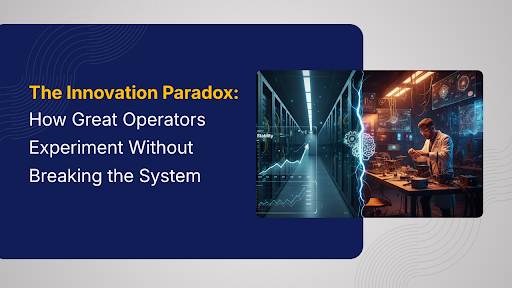
Most companies swing between two extremes: wild experimentation that burns efficiency or rigid execution that suffocates innovation. The real skill, the one very few teams master, is building a system that can do both at the same time.
Over the years, I have learnt that innovation is not a mindset problem or a talent problem. It is a design problem.
And the solution is not cultural fluff like “move fast” or “be agile.” It lies in building what researchers call an ambidextrous organisation where one part of the company protects stability, and another part learns how to break things safely.
Here are the non-obvious truths I wish someone had told me earlier.
1. Innovation fails when it tries to live inside BAU (Business-As-Usual)
The most common mistake I see is that teams attempt to innovate within the same processes, KPIs, and review cycles designed for steady-state operations. And this guarantees failure.
In my previous organisation, we had a Business Technology Function, which was separate from the Organisation Product and Engineering Team. The key reason was to bring agility to the technology solution for in-house business operations because keeping the house running was very important. If it were merged with the Organisation Product and Engineering Team, getting the right bandwidth and prioritisation would have been the toughest negotiation since the objective of the organisation team was focusing on Customer Experience.
Execution teams are optimised for:
- predictability
- accuracy
- SLA discipline
- removing variance
Innovation teams survive on:p
- variance
- speed
- informed risk
- learning from failure
When these two live inside the same structure, one will always kill the other.
So, innovation does not need inspiration. It needs separation.
2. The smartest companies treat innovation like a portfolio, not a project
Most leaders treat innovation as a linear process: start, build, evaluate, and scale.
Strong operators do not do this. They run portfolios of experiments with built-in probabilities:
- 60–70 percent: incremental improvements
- 20–30 percent: adjacent ideas
- 5–10 percent: high-risk bets
This protects the core business while ensuring there is always something new in the pipeline.
The portfolio approach answers the real question: “How much failure can we afford without losing momentum?”
Most teams skip this. That is why their innovation feels emotional, political, and unpredictable.
You can think of it in terms of BCG’s Growth Matrix Framework, but for processes.
3. The hardest part is not experimentation but the handover
Successful pilots die quietly during the “handover stage.” Why?
Because teams celebrate a pilot’s success without doing the two things that matter:
- Define the exact operational owner.
- Map the cost of absorbing the new process into BAU.
Pilots fail not due to poor innovation, but due to poor integration.
The operators who scale consistently build a “landing strip” before a pilot even starts.
In my earlier days, I made a critical mistake during the handover stage, where I started looking for buy-in during handover and also fitting it as a jigsaw puzzle. This led to a key issue of non-acceptance since during the time the solution was developed, the team had made several changes in the process, which made the solution delivered an orphan.
4. Expectation management is the real leadership skill
Innovation collapses when leaders oversell the upside and undersell the transition cost.
The most effective leaders I have worked with do one thing consistently: They teach stakeholders the difference between experimentation, validation, and adoption. This reduces noise, impatience, and unrealistic timelines.
When people understand where an experiment sits on that ladder, they support it more and fight it less.
5. Killing projects is a sign of maturity, not failure
Organizations that innovate well do one thing ruthlessly:
They kill projects as soon as the data stops supporting them.
It’s not done after a big review or one more attempt or because someone senior “feels strongly.” They kill it at the moment it no longer earns its cost of survival.
This is how they protect both innovative energy and operational credibility.
Final Thought: Operators Don’t Choose Between Stability and Innovation; Rather, They Design for Both
If there is one thing my own experience with high-risk AI experimentation has taught me, it is this:
Innovation and operational excellence are not opposites. They are interdependent when designed intentionally.
Great teams do not innovate everywhere. They innovate exactly where the system can absorb it.
And once the system is ready, they scale fast without breaking trust, execution, or culture.
That is the real innovation paradox, not choosing between exploration and efficiency, but learning how to make them strengthen each other.
#Innovation #OperationsExcellance #Operations #Customerservice #BusinessGrowth